

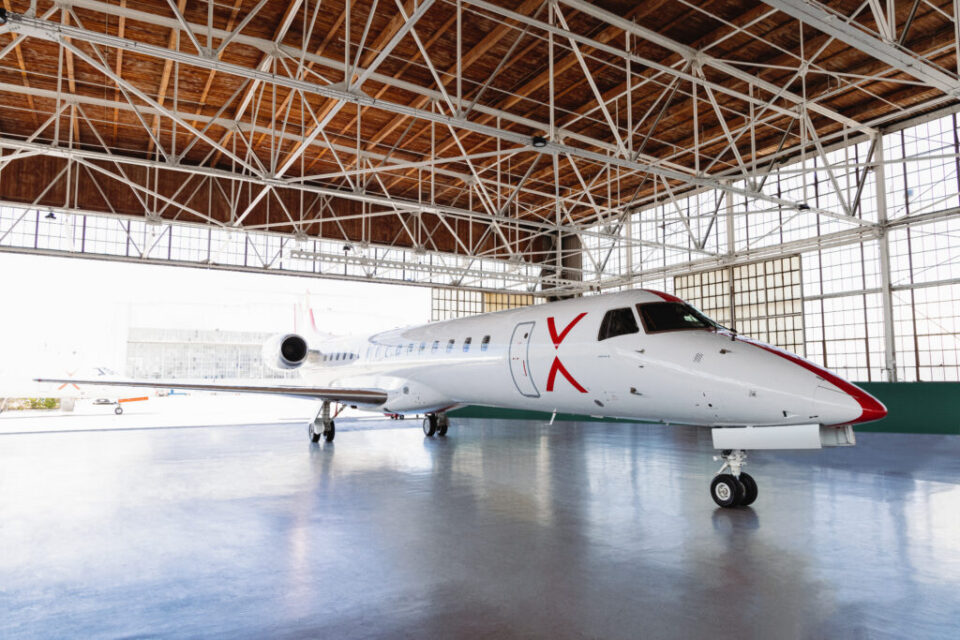
Even prior to last year’s JetSuiteX expansion at John Wayne Airport, commercial flights were steadily on the rise while general aviation fell by 8.5% in only one year.
Orange County residents living under the flight paths of John Wayne Airport (SNA) should, for better or for worse, expect to see more jets in the skylines of the very near future.
Last year, Supervisor Katrina Foley helped champion a relocation plan that expands JetSuiteX’s footprint at SNA, bringing more scheduled jet traffic into an airport already struggling with limited space and growing tension between quasi-commercial operators and the traditional general aviation (GA) community. As part of that plan, JSX’s cap on the number of annual passengers was increased by around 27%, from 95,000 to 130,000.
Prior to this, the number of jets flying in or out of SNA was already on the rise. Last year, the airport saw 94,388 commercial flights—an increase over the 92,760 in 2024.
Confusingly, JSX flights are not even included among those figures. Nor are they included among Orange County’s Air Quality Improvement Plan. This is because county officials have allowed JSX to be classified as general aviation, though that term generally (but not exclusively) refers to private pilots operating small piston engine and propeller-driven aircraft. These are aviators that, on average, fly only 35–50 hours annually, which equates to 1–2 local flights or short trips per month.
Conversely, JSX jets come and go daily.
Foley’s messaging tends to emphasize that JSX complies with curfews and noise rules—though it’s worth stressing that this compliance is voluntary, not mandated. JSX does indeed employ Embraer 135 and 145 aircraft which are quieter than the larger jets in use by commercial airlines out of SNA. But noise pollution is only one part of the equation.
A privately owned Cessna sitting in a hangar for a week does not generate the same airport activity as a scheduled Embraer shuttle running multiple passenger loads per day. As SNA allows JSX to take more passengers, that equates to rideshare traffic around the airport; more ground congestion; more people cycling through a facility already operating under some of the tightest space constraints in Southern California. Expanding scheduled jet operations inside facilities originally intended for general aviation pushes more stress onto every part of that system.
The county’s own history shows it understood this problem back when it approved SNA’s the GAIP in 2020. The Board initially restricted JSX’s access to private FBO terminals. JSX filed a federal lawsuit and the county ultimately abandoned its prohibition on commuter jet operations out of the FBOs.
Many in the aviation community saw this as the first in what would become a string of concessions made to JSX for which they would ultimately pay the price—both figuratively and literally.
For context, in a piece written last year, Jonathan Welsh of Aviation Consumer wrote that “hangar rental fees [at] some of the busier, most desirable fields [charge] north of $1,000 per month,” adding that “thousand-dollar-a-month hangars are not typical, and the sweet spot for rental rates among the airports [he] checked seems to lie between $400 and $500.”
How does SNA compare? At the time of that article being written hangar fees averaged around $1,700 to $2,000 per month for a standard-sized piston aircraft.
On top of that, pilots in the running for a hangar at SNA face a 10-year waiting list. This is not a new development, as evidenced by this OC Register piece from 2019. Had author Alicia Robertson had applied for a hangar on the day her article was published, she’d still conceivably have another three years of waiting ahead of her, based on averages.
“As the County embarks on its $700 million in capital improvements, we remain committed to offering the best options for our millions of customers while protecting what we love about our airport, including our local pilots who call John Wayne Airport home,” said Foley after the expansion was approved last year.
But many of those selfsame local pilots now feel iced out of that home. It has become increasingly difficult and costly to secure hangar space at SNA—an airport which has historically been a staunch supporter of small aircraft aviators. To that point, general aviation fell by 8.5% between 2024 and 2025. And that number would realistically be even lower if JSX wasn’t counted among their ranks.
In short, the number of small plane flights are going down while jet flights are on the rise.
That matters because the former tends to consume relatively little fuel, carry few passengers, and produce significantly lower exhaust output than regional jets. Their operating speeds are slower, and their wake turbulence and taxi demands are comparatively minor. Small piston aircraft are a great deal quieter and seldom fly at night.
And while a Cessna 172 burns roughly 6–9 gallons of gas per hour through a piston engine, an Embraer regional jet burns jet fuel at around 340 to 660 gallons per hour (GPH) and produces turbine-engine emissions associated with ultrafine particulate matter, NOx compounds, and black carbon soot.
As previously reported, as part of the expansion, JSX was given 1.2 acres of space that the county had dedicated for general aviation as part of an amendment to the GAIP in 2020. It was a way to offset the elimination of 242 small GA spaces and displacement of over 200 small aircraft.
Previously, there were only about a dozen small airplanes parked in that acreage since Jay’s Aircraft Maintenance had relocated them to make room for the JSX deal. As a result, Foley has been able to repeatedly understate the amount of space this deal actually strips away.
“Foley gave JSX 1.2 acres of precious small GA land that was protected by the Steel Amendment and then included in the Fixed Base Operator (FBO) leases,” said Southern California Pilots Association representative Craig Ryan. “1.2 acres can park at least 30 small aircraft and Foley is attempting to characterize this as ‘only 8 tie-down spaces.’”
Ryan pointed out that Jay’s has also significantly increased their tie-down rates and are charging more than ACI Jet, who currently has more than 100 on their tie-down waiting list and more than 100 on their hangar waiting list.
