

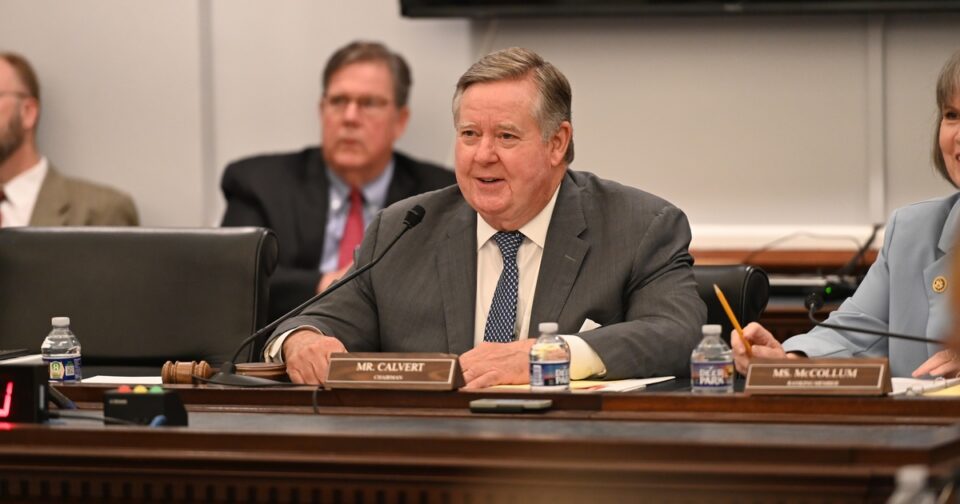
The California Republican has backed voter ID at both the federal and state levels as Proposition 39 approaches a November vote.
Rep. Ken Calvert, R-Calif., is making voter identification a prominent part of his election-security agenda Thursday as he campaigns for California’s newly drawn 40th Congressional District and voters prepare to decide Proposition 39, which would impose new identification requirements for in-person and mail voting in November.
Calvert recently pointed to his vote for the federal SAVE America Act while describing voter ID and citizenship requirements as basic election safeguards.
“I voted for the Save America Act because voter ID and making sure only U.S. citizens vote is just common sense,” Calvert said.
Calvert has also made the issue part of his case to voters. In his official Riverside County candidate statement, Calvert specifically highlighted his support for both federal legislation and the California initiative.
“I strongly believe we should improve the integrity of our elections by making Voter ID mandatory,” Calvert said.
His involvement has extended beyond public statements. Federal Election Commission records show the Ken Calvert for Congress Committee reported making a $150,000 loan to Californians for Voter ID in November 2025, with the filing later recording a repayment in December.
Calvert also voted in February for the SAVE America Act, which passed the House 218-213 and would require photo identification to vote in federal elections while imposing documentary proof-of-citizenship requirements for registration.
At the state level, Proposition 39 would require government-issued identification for in-person voting and require mail voters to provide the last four digits of a designated government identification number. California currently does not generally require voters to present identification at polling places.
The measure faces a competitive statewide fight. An August Berkeley IGS Poll found 51% of likely voters opposed Proposition 39 and 42% supported it. The poll surveyed 4,207 registered voters from Aug. 3-9 and reported an overall margin of error of 2.5 percentage points.
