

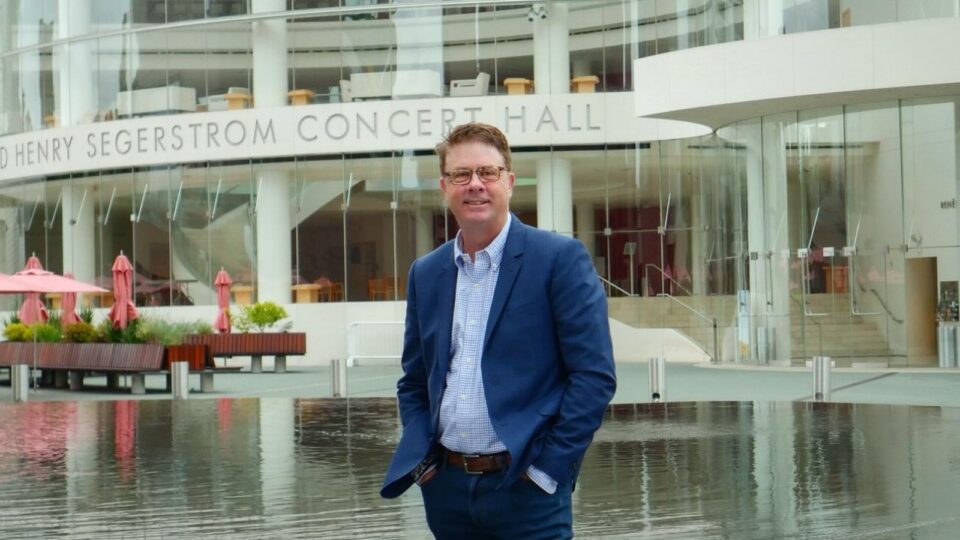
Costa Mesa’s mayoral race comes down, in part, to a question about the role of local government. One candidate, as you’re about to read, argues the city has lost focus on basic municipal services by devoting time and resources to political activism and issues he believes belong to state and federal government.
His opponent declined to speak to us.
We reached out to both mayoral candidates, Councilmembers Mike Buley and Loren Gameros, via email with the same list of questions. Only Buley submitted responses. After two weeks and multiple attempts to reach Gameros, he simply replied “No” without punctuation.
The following is our conversation with Buley, who outlined his priorities for the city and explained where he believes Costa Mesa’s current direction has fallen short.
Mike Buley currently serves on the Costa Mesa City Council representing District 1. He has held the position since 2024. Beyond that, Buley has been a resident of Costa Mesa for over 20 years, where he and his wife have raised their three children. He has owned his own business litigation law firm for over three decades.
He argues his race is focused on returning the City’s focus to the basics: safety, roads, parks, infrastructure, and “efficiently delivering services to the people who live, work, visit, and invest here.”
“We have drifted into activism and attaching ourselves to national issues that divert our attention and resources away from serving the basic needs of the community,” said Buley.
For examples of issues where the City has spent time and resources are—in Buley’s opinion—beyond the jurisdiction of its practical and legal powers, Buley points to the development of a Climate Action Plan. He argued that both the City and local businesses are already burdened by existing federal, state, and county regulations, “yet we look to add our own to little or no effect on the problem and with negative effect on the business community.”
Another example would be the Council majority “recently [injecting] itself into the middle of the Federal and State regulated collective bargaining framework” by passing an ordinance earlier this year which directs local grocers to staff their automated check-outs. Stores that refuse to comply are subject to fines and penalties.
When asked what Costa Mesa’s greatest challenges facing the community are, Buley cited looming budgetary issues, navigating the state mandated housing element and related zoning issues, and ensuring the community stays safe and well-maintained.
For context on budgetary woes, City staff recently reported a shortfall of roughly $1.9 million to $2.9 million which could swell to an anticipated gap of $4.9 million to $6.5 million in subsequent fiscal years. As a result, the Council voted 5-2 to approve a tax increase ballot measure which, if accepted by voters, would increase the maximum tax cap by 75 times its existing rate: from $200 to $15,000 annually.
Buley was one of the two dissenting votes—the other being Councilmember Jeff Pettis.
Naturally, we wanted to ask Buley about his position on the Fairview Developmental Center. As detailed in our profile on District 3 candidate Daniel Morgan, this is a contentious, hot-button issue in Costa Mesa concerning the fate of a roughly 95-acre site, 80 of which will be zoned for housing. The question has been how much.
The Center is, in Buley’s own words, “one of the last remaining significant development site opportunities.” “How it is developed will determine the future character and quality of the City for generations,” he said.
On August 10 of this year, the Planning Commission voted 4-2 to recommend a draft land-use plan that allowed for up to 4,000 residential units. The main argument for this plan was that it would help Costa Mesa meet the affordable housing unit quota imposed by Sacramento. But residents and local control advocates were largely critical of this move, arguing that adding thousands of units would funnel heavy traffic directly onto an already-busy Harbor Boulevard.
The high-density buildout would have also caused the City to fall far short of its own designated parkland and open space standards.
The following month, Buley joined his colleagues on the City Council in unanimously approving a 2,300-unit housing plan, massively scaling back the earlier staff proposal.
Buley stated his position has been to fight for a space that is “carefully planned to be a real jewel of a community in the heart of our City with homes, condos, and green space and amenities where people can really ‘live,’” rather than “high density housing with limited or no green space.”
After years of reviewing plans, it looks like Costa Mesa residents may finally soon get to enjoy the former.
We asked if there’s anything else Buley would like readers to know.
“I grudgingly came to service as an elected when I was asked by friends and neighbors to run for City Council. I likewise have been asked to step up and serve as Mayor,” he responded. “I’m humbled by the faith and support I have received from my friends, families, and members of the community.”
For more on Buley and his race, please see his responses to the Orange County Register’s 2026 election questionnaire.
