

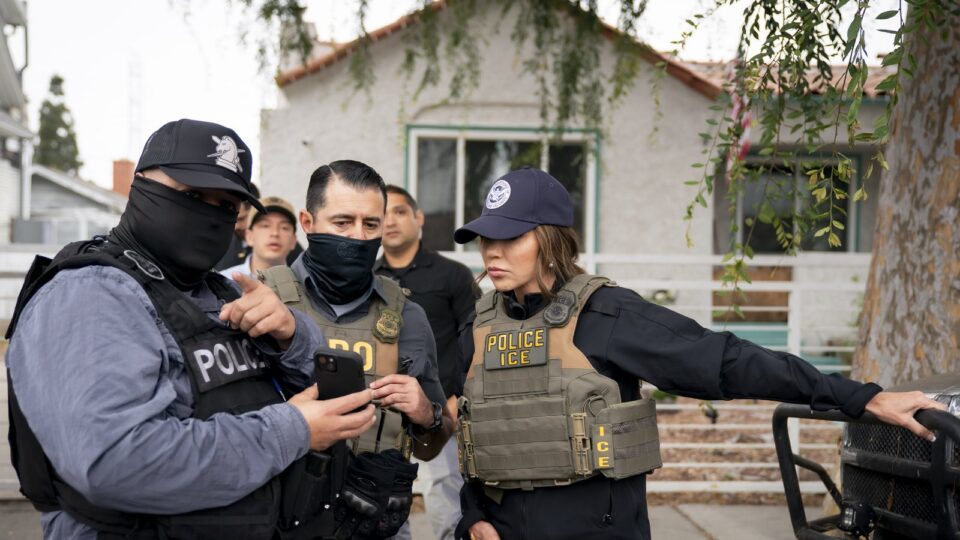
A federal judge in Los Angeles entered the order Tuesday, Nov. 17, after the state and the Justice Department filed a joint stipulation ending a year of litigation.
U.S. District Judge Christina A. Snyder on Tuesday, Nov. 17, entered a permanent injunction barring California, Gov. Gavin Newsom and Attorney General Rob Bonta from enforcing the state’s mask ban and officer-identification laws against federal agents, after the parties jointly asked the court to end the case.
The two-page order, filed in the Central District of California, came one year to the day after the Justice Department sued the state, Newsom and Bonta over the laws. The department announced the result Thursday, Nov. 19, and said the lawsuit was dismissed “pursuant to the parties’ final resolution.” The injunction bars enforcement of Government Code Sections 7288 and 7289 and Penal Code Sections 185.5 and 13654 against the United States, federal law enforcement officers and federal law enforcement agencies. The injunction does not bar the state from enforcing the laws against local officers.
Newsom signed the two bills on Sept. 20, 2025, after a public campaign against federal immigration enforcement tactics in California. In his signing message on SB 627, the No Secret Police Act, Newsom wrote, “Acting on behalf of an authoritarian President, federal immigration authorities are spreading fear and terror throughout California with indiscriminate raids that have rounded up American citizens, people legally in the United States, working parents, and even children.” “America should never be a country where masked ‘secret police’ grab people off the streets and throw them into unmarked vans and speed away,” he wrote.
State Sen. Sasha Renée Pérez of Pasadena, the author of SB 805, the No Vigilantes Act, said the same day that the measure “responds to troubling immigration enforcement activities in which masked agents have seized people off the street without showing an agency name, personal identification, or badge number, alongside a rise in law enforcement impersonation cases and efforts in other states to recruit bounty hunters for immigration enforcement.”
SB 627, Chapter 125 of the Statutes of 2025, makes it a crime for a law enforcement officer, a definition that includes federal officers as well as officers employed by a city, county or other local agency, to wear a facial covering that conceals or obscures their facial identity while performing their duties, except for listed exemptions such as undercover work, SWAT assignments and occupational safety gear. A willful and knowing violation is punishable as an infraction or a misdemeanor. The law also required law enforcement agencies operating in California, including any federal law enforcement agency, to maintain and publicly post a written policy on facial coverings by July 1, 2026.
SB 805, Chapter 126 of the Statutes of 2025, requires a law enforcement officer who is not uniformed, including a federal officer, to visibly display identification that includes their agency and either a name or badge number, or both, when performing enforcement duties, with listed exemptions. A willful and knowing violation is a misdemeanor. Agencies, including federal ones, were required to post a written identification policy by Jan. 1, 2026, when the criminal identification requirement took effect.
The United States filed the lawsuit on Nov. 17, 2025, arguing the laws violated the Constitution’s Supremacy Clause by attempting to regulate federal operations and, in the case of the mask ban, by discriminating against the federal government.
On Feb. 9, Snyder granted the government a preliminary injunction in part. “California may not enforce the facial covering prohibition of the No Secret Police Act, SB 627 § 3, against federal law enforcement officers,” her order said. She denied a preliminary injunction on the other challenged provisions, including the identification requirement.
The government appealed the identification ruling. On April 22, the U.S. Court of Appeals for the Ninth Circuit blocked California from enforcing Penal Code Section 13654 against federal agencies and officers while the appeal proceeded. On Oct. 14, a three-judge panel reversed Snyder’s denial and directed her to enter a preliminary injunction on that provision. “As before, we conclude that the United States is likely to succeed on the merits of its Supremacy Clause claim because § 10 of the No Vigilantes Act attempts to directly regulate the United States in its performance of governmental functions, and Congress has not authorized such regulation,” Judge Mark J. Bennett wrote, joined by Judges Jacqueline H. Nguyen and Daniel P. Collins. “Indeed, we conclude that the United States is certain to succeed.”
On Nov. 13, the United States, the state, Newsom and Bonta filed a joint stipulation for judgment, with a proposed permanent injunction. Snyder signed the order Tuesday, Nov. 17, dismissed the case with prejudice as to all defendants, and retained jurisdiction to implement and enforce the final judgment.
The order includes no concession by California that the laws are unconstitutional, and neither Newsom’s office nor Bonta’s office had issued a public statement on the permanent injunction by Monday afternoon.
“Today’s permanent injunction confirms a basic constitutional principle: states do not have the authority to regulate the Federal Government or dictate how federal law enforcement officers perform their official duties,” Associate Attorney General Stanley E. Woodward, Jr. said in the Justice Department’s Thursday statement. “The Constitution does not permit states to interfere with federal operations or place federal officers and their families at risk.”
“This permanent injunction protects both the supremacy of federal law and the safety of federal law enforcement officers,” said Acting Assistant Attorney General Jonathan D. Guynn of the department’s Civil Division. “The Federal Government, not the states, gets to decide what equipment federal officers may use and what measures they may take to protect themselves while performing their official duties.”
