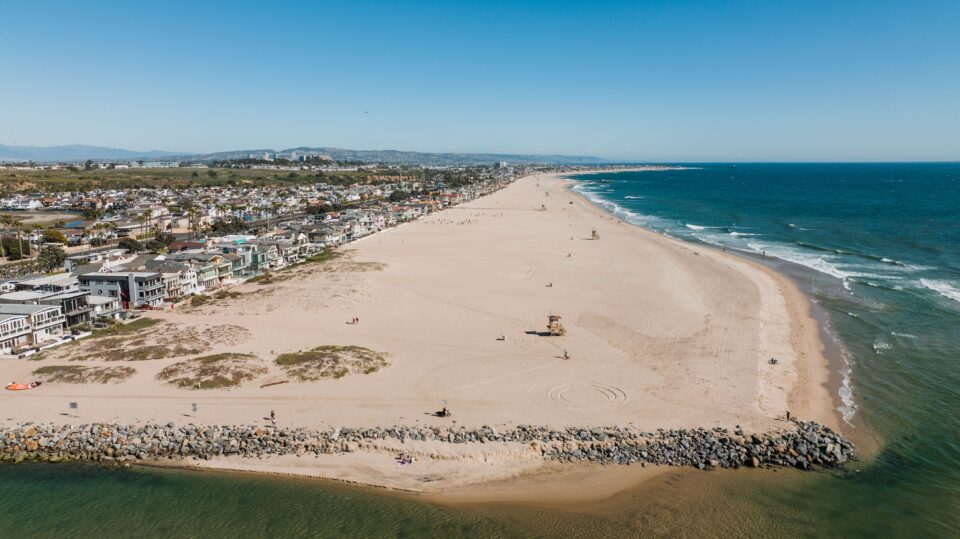
Orange County Glyphosate residuals detected in independent testing at Doheny Beach and Santa Ana River outlet nearly 18 months after the county stopped spraying.
Nearly a year and a half after Orange County stopped spraying glyphosate in creeks that empty into its beaches, independent testing still found traces of the chemical.
The push to halt herbicide use has rippled throughout Orange County for months, leading many to question what could be lingering after public workers stop spraying. During the California Courier’s initial investigation into the county’s spraying, both major labs, Eurofins and Weck, turned down a request to sample soil and water from both the Santa Ana River and Doheny State Beach.
Due to the denial over concerns about contracts, both of which have had contracts with the county, the samples were sent to the Health Research Institute (HRI) in Iowa to be studied for a variety of different chemicals.
Concerns over the amount of herbicides being sprayed first ignited in January after Creek Team OC, a resident-motivated group, started pushing the issue. Public pressure first focused on Orange County Board of Supervisors Katrina Foley, since Creek Team OC began in her district and had already tried reaching out to her office multiple times.
By February, Foley addressed the public pressure in a statement, noting that she wanted to assure constituents that RoundUp/glyphosate had not been “applied to the Trabuco or San Juan Creek Flood Control since January 2025” and wouldn’t be applied in the channels again.
“The County is only permitted to apply State Water Board and EPA-approved herbicides to manage vegetation in flood control channels. We will continue balancing environmental needs while protecting lives and property from the threat of flooding,” the post stated.
THE RESULTS
Collecting samples in May from two downstream locations from opposite ends of the county, both still showed residual glyphosate and its primary breakdown product, AMPA. AMPA is what glyphosate turns into as it breaks down, and it tends to stick around longer in soil and sediment than glyphosate itself.
At Doheny Beach, downstream of the San Juan and Trabuco system, water tested at a “trace” level of glyphosate. Soil from the same area contained 2.17 ng/g of glyphosate and 2.73 ng/g of AMPA.
The same Doheny soil sample also showed a trace of TCP (3,5,6-trichloro-2-pyridinol), a breakdown product that can come from the insecticide chlorpyrifos and, in some cases, from other related chemicals like triclopyr.
At the Santa Ana River outlet near the jetties, water showed no detectable glyphosate but 0.04 parts per billion of AMPA. Soil from that site had no detectable glyphosate and 2.59 ng/g of AMPA.
The numbers are below California’s drinking-water limit of 700 parts per billion for glyphosate.
While officials could potentially point to new findings arguing that the levels are too low to matter, those limits were built mostly on studies the manufacturers themselves submitted. Independent long-term research on repeated low-level exposure is thinner and hasn’t all landed in the same place.
What the residuals actually raise is a different set of questions. Orange County has not publicly released independent testing of residual glyphosate or AMPA levels in these channels since January 2025 stop.
THE CONCERNS
Glyphosate usually breaks down in weeks to a few months. AMPA, the main thing it turns into, lasts a lot longer. Field studies have found it can show up in soil and sediment many months later, and sometimes more than a year after the last time it was sprayed.
What those lingering amounts could mean for health is still contested. The International Agency for Research on Cancer (IARC), part of the World Health Organization, classified glyphosate as “probably carcinogenic to humans,” pointing mainly to links with non-Hodgkin lymphoma.
However, regulatory agencies like the Environmental Protection Agency (EPA) have disagreed, stating the chemical is not likely to cause cancer at typical exposure levels.
California’s drinking water standards for glyphosate track the federal approach, basing the limits primarily on non-cancer endpoints. However, at the same time, the state previously listed glyphosate under Proposition 65 in 2017, marking it as a chemical known to the state to cause cancer following the IARC classification.
The dual posture leaves a gap: the same chemical is treated as a carcinogen for warning purposes while the enforceable drinking-water limit remains relatively high.
Some independent studies have also raised questions about other possible effects on issues like hormones, the gut microbiome, and development. But those findings are not settled and have not been adopted into the current drinking-water limits.
As for AMPA, it has been studied far less than glyphosate itself.
TCP also has its own set of questions. According to data, it tends to last longer in the environment and move more easily through soil and into water than some of the parent chemicals it comes from.
Lab studies on TCP have shown liver and kidney effects in mice after repeated oral exposure, with other liver cell studies showing signs of oxidative stress, DNA damage, and cell death.
Currently the EPA and IARC do not classify TCP as a known or probable human carcinogen, however, there are no long term human studies. Studies on the chemical do show it can be toxic to aquatic life, including fish and invertebrates.
THE BACKGROUND
For years, Orange County Public Works (OCPW) has sprayed herbicides across the county’s flood control channels, stating it is necessary to keep vegetation from blocking water flow. Public records reviewed by the Creek Team OC put the annual total at more than 100,000 gallons for some years, with some accounts close to 150,000 gallons.
The chemicals used throughout the years have included glyphosate (the active ingredient in Roundup), triclopyr, imazapyr, and other herbicides, along with additives meant to help them stick and spread. Those channels then drain toward the ocean, including into the same system that empties at Doheny State Beach.
Notably, the same San Juan and Trabuco creeks are also the focus of a long running effort to restore habitat for the endangered Southern California steelhead trout.
Federal and state agencies have poured over $20 million into the protection of the endangered steelhead trout, seeking to build fish passage and recovery projects in the watershed for over two decades.
In addition to the glyphosate pause in 2025, Foley announced a broader countywide pause on herbicide use in flood control channels.
With concerns around herbicide use reigniting in July at a recent Ladera Ranch town hall focused on a cluster of rare childhood cancers, Foley said she has long opposed the use of herbicides in public spaces and waterways.
Board records from 2021 and 2022, however, show the Board of Supervisors (including Foley, Supervisor Don Wagner, and Supervisor Doug Chaffee) approved amendments that continued to fund the county’s main herbicide application contracts during those years.
Board documents show the primary herbicide application contracts were authorized at nearly $3 million between 2018 and 2023. Actual spending under those contracts reached about $1.47 million by late August 2023, according to records.
The California Courier reached out to the board, OCPW and Foley’s office for comment, but none responded.