

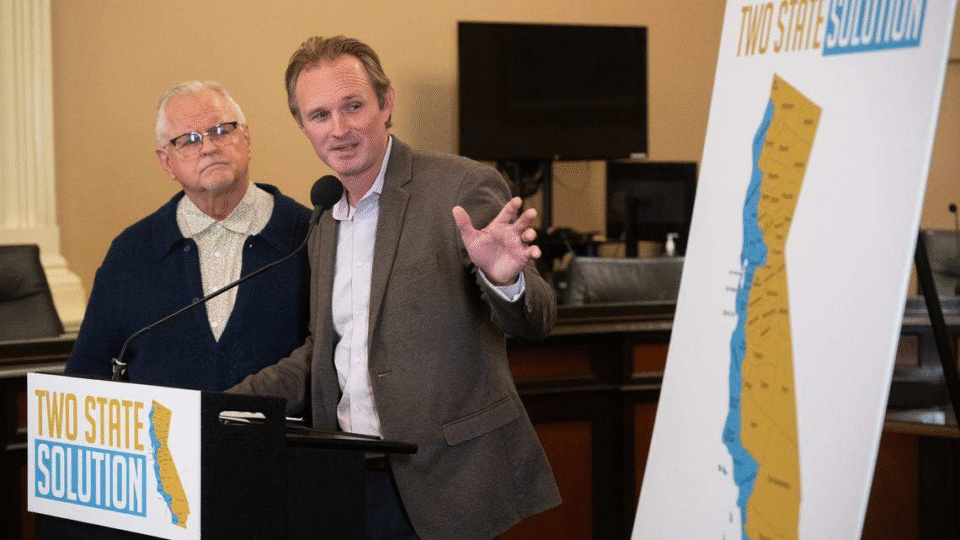
Assembly Minority Leader James Gallagher unveils legislation to carve a new inland state out of 35 California counties, arguing coastal elites have long ignored rural voices.
In a bold response to the Democratic-controlled state’s redistricting plan, Assemblyman Minority Leader James Gallagher (R-East Nicolaus) introduced Assembly Joint Resolution 23 last Wednesday, proposing to split California into two distinct states.
“The people of inland California have been overlooked for too long. It’s time for a two‑state solution,” Gallagher said in a statement unveiling the measure, which would split the state—with a new inland state comprising most of Northern California, the Sierra Nevada, the Central Valley, and the Inland Empire—separate from the liberal coastal areas such as Los Angeles and Sacramento County.
Gallagher went on to argue that the amendment is a necessary response to Democratic redistricting plans he believes would “silence rural voices and rig the political system against them forever.”
Gallagher’s proposal arrives amid a pitched partisan battle over congressional maps. Democrats have scheduled a special election in November to approve a redistricting plan they claim is aimed at ensuring fair representation—but which Republicans deride as a “gerrymandered” power grab.
In the text of AJR-23, Gallagher argues that California’s population is “highly concentrated in certain urban and coastal areas,” while vast inland regions are “underserved by a government heavily influenced” by those coastal representatives. The resolution references past secession movements, noting that in 1859, California voters approved a split, but Congress did not act due to the impending Civil War.
It also cites more recent efforts: “In the last decade, several counties in northern California … have expressed the desire” to form a new state, and in 2022, San Bernardino voters passed a measure supporting research into secession.
Gallagher’s “two-state solution” isn’t a novel idea. Previously floated partition concepts—such as the 2017 “Cal 3” measure—failed to qualify or were rejected from ballots. Constitutional hurdles remain steep: any new state would require not only voter approval in California but also consent from the U.S. Congress, as outlined in Article IV, Section 3 of the U.S. Constitution.
While unlikely to pass, the proposal serves as a pointed declaration of conservative frustration in California—and a launchpad for messaging into the 2026 midterm season.
