Bill Essayli cracks down on California Medicare fraud with major arrests and warns scammers time’s running out.
First Assistant U.S. Attorney Bill Essayli marked his first year in the Department of Justice by taking on one of California’s biggest problems: fraud. His message to those breaking the law is simple — time is running out.
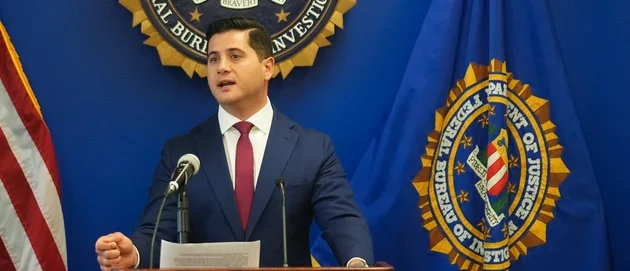
Early Thursday morning, Essayli joined a handful of officials and law enforcement leaders to announce the arrest of eight people allegedly involved in a massive Medicare fraud scheme that billed taxpayers millions for care provided to the “dying.” The investigation began in January, when Essayli and Centers for Medicare and Medicaid Services Administrator Dr. Oz held a press conference announcing they would target California over alleged fraud.
“Dr. Oz came and visited and we discussed prioritizing healthcare fraud, particularly hospice fraud or in-home healthcare. As a result of that meeting, we scheduled this takedown operation for early April and then we worked backwards,” Essayli told the California Courier.
Upon working “backwards,” Essayli stated the DOJ took the “best cases” they had that were “close to being charged,” assigning them to get “worked up with the agencies as quickly as possible” for the takedown.
The operation, conducted in coordination with the Federal Bureau of Investigation and Vice President JD Vance’s Task Force to Eliminate Fraud, was later dubbed “Operation Never Say Die.” (RELATED: Michael Gates Blasts Bonta For Trying To Shut Down Sheriff Bianco’s 45K Prop 50 Probe)
In Thursday’s press release, those arrested included three nurses, a chiropractor and a psychologist, who allegedly schemed to defraud the nation’s health care system out of more than $50 million. Officials said the scheme involved running sham hospice care facilities that billed Medicare “by using people without terminal illnesses as beneficiaries.”
But even with the recent arrests, Essayli told the Courier that some of the cases brought forward on Thursday had been in “the hopper” for a while.
“The government’s obviously known about this fraud for a long time, but there hasn’t been much of an appetite or an interest to move them along,” Essayli said. “One of the cases – I mean, they executed a search warrant like 2022 and just sat there languishing.”
“So that’s what priorities are for and that’s what leadership is for,” Essayli added. “We set what we’re going to be prosecuting and for whatever reason, the prior [Biden] administration, it just wasn’t a priority.”
Among the suspects was 65-year-old Lolita Beronilla Minerd, a licensed vocational nurse charged with health care fraud. According to officials, Minerd owned and operated Topanga Hospice Care Inc., allegedly using the company to submit more than $9,174,117 in fraudulent hospice claims to Medicare, which paid more than $8,510,448 on those claims from July 2020 to April 2025.
Another suspect was 76-year-old Nita Almuete Paddit Palma, a thrice-convicted health care fraudster, and her husband, 68-year-old Adolfo Catbagan. Officials charged the married couple in an 11-count indictment with operating at least three fraudulent hospice care facilities, even while Palma was free on bond awaiting trial on a separate hospice fraud case.
When asked about Palma’s pending trial, Essayli pointed out that pretrial officers were supposed to be monitoring her. The DOJ detected her continued activity while she was under supervision. Palma’s bond privileges have since been revoked.
“It goes more to show you how emboldened these fraudsters are. Even while they’re facing criminal charges and facing trial, they continue to perpetuate the fraud,” Essayli told the Courier.
“The only thing I could surmise is that they’re so addicted to that much money, to making that much money so quickly, it’s very hard for greedy people to stop doing it,” Essayli continued. “So we have to tighten up our systems.”
Tighter regulations were supposed to take effect in the state by January 1 under emergency rules pushed by the state auditor, who said California needs stricter oversight on who receives hospice agency licenses and how they are monitored.
“But the governor [Gavin Newsom] is refusing to do it. So you really have to ask why,” Essayli said.
In addition to the state’s lack of enforcement, Essayli’s office faces another major obstacle: a shortage of prosecutors in the Central District of California. Essayli said his office is currently operating with about half as many fraud prosecutors as it normally would.
“I would really encourage if there are junior lawyers out there who have been practicing even just one or two years at a law school and they want to become federal prosecutors, I would seriously encourage them to consider applying,” Essayli said.
With medical fraud as the most recent takedown, Essayli noted that his team is covering “it all,” which includes violent organized crime, homelessness and public corruption.
When asked if he had one message for those still committing fraud in the state, Essayli simply stated: “Tik, tok.”