

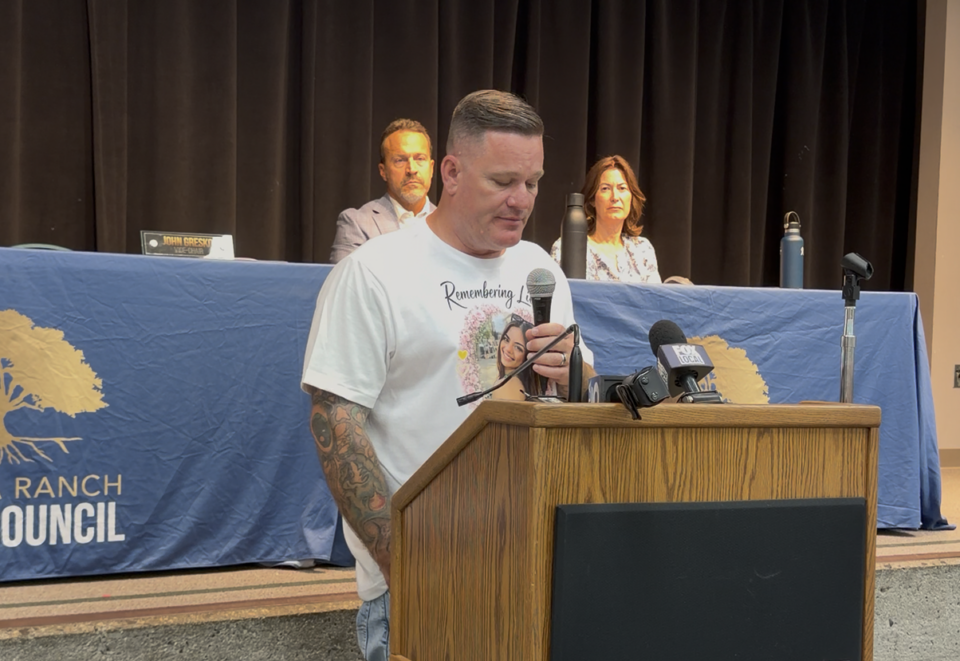
LADERA RANCH: About 400 people packed a community meeting Tuesday night, demanding a full investigation after at least six children connected to the master-planned community were diagnosed with Ewing sarcoma since 2013, a cancer so rare that only 200 to 250 children nationwide are diagnosed each year, according to the American Cancer Society.
The Civic Council took up a special agenda item titled “Community Health Concerns,” where residents pushed to ban toxic herbicides in their neighborhoods.
Brian Dalton put a face on the numbers. His daughter Lily died in January at 23, and genetic testing found her tumor carried an Ewing sarcoma gene fusion. “I don’t want another family planning a funeral instead of a future,” Dalton told the crowd. Another family, the Mattesons, lost 17-year-old Brody to the disease this year.
Suspicion centers on landscaping chemicals. Residents described repeated exposure to pesticides and herbicides sprayed through the community, and Brent Linas of the Orange County Creek Team urged officials to examine whether that exposure poses health risks. In response, the Ladera Ranch Maintenance Corporation announced a 60-day pause on routine use of certain pesticides and herbicides while it reviews its landscaping practices, calling the move precautionary. Civic Council members have framed the requested moratorium the same way: caution, not accusation.
Elected officials at every level are now on the record.
Orange County Supervisor Katrina Foley sent a July 17 letter to state Public Health Officer Dr. Erica Pan demanding the state expedite its review and give residents timely, transparent updates. “Ladera Ranch families deserve answers, transparency, and urgency from the state,” Foley said. At the meeting, she pointed the responsibility squarely at Sacramento. “This is a State of California public health issue,” Foley said. Her office says the county Health Care Agency first asked the California Cancer Registry to evaluate concerns in 2024, when no discernible pattern was found, and has now asked the registry, UCI’s Cancer Center, and the county Agricultural Commissioner to revisit the data. Results are pending. County Public Works has already switched to steam instead of herbicides on Ladera Ranch residential streets, and Foley has pressed LARMAC to adopt non-toxic practices.
Assemblymember Diane Dixon said lawmakers are mounting a joint review across multiple levels of government to understand potential environmental exposures, promising a thorough and transparent investigation. The goal, she said, is to “save lives and families and have healthy communities.” Days earlier, Dixon said her stance on pesticide use “has been and will continue to be unequivocal and non-negotiable,” insisting anyone applying the chemicals must uphold the highest safety standards under existing law. State Sen. Catherine Blakespear has likewise pledged to stay engaged in the investigation.
Assemblymember Kate Sanchez formally called on Gov. Gavin Newsom on Monday to launch a “coordinated, state-led investigation.” And the pressure is now federal: First Assistant U.S. Attorney Bill Essayli sent a letter asking the EPA to investigate whether environmental factors are driving the cases and whether federal environmental laws are implicated, saying potential exposures should be evaluated through a “systemic, science-based process.”
The science urges patience. Health officials have not confirmed a cancer cluster or identified any cause. A CDPH spokesperson said Ewing sarcoma is so rare that small case counts make statistical interpretation difficult. City of Hope physician-in-chief Edward Kim said clusters like this can be chance, and childhood cancer epidemiologist Logan Spector, already contacted by Ladera Ranch families, said Ewing sarcoma is not generally driven by environmental causes, with ancestry as its strongest known risk factor.
For the parents who filled the room Tuesday, that uncertainty is the point. A law firm, Bond Legal, is now gathering cases from families whose children lived in or regularly visited the community, and the county’s updated data review is expected in the coming weeks.
