

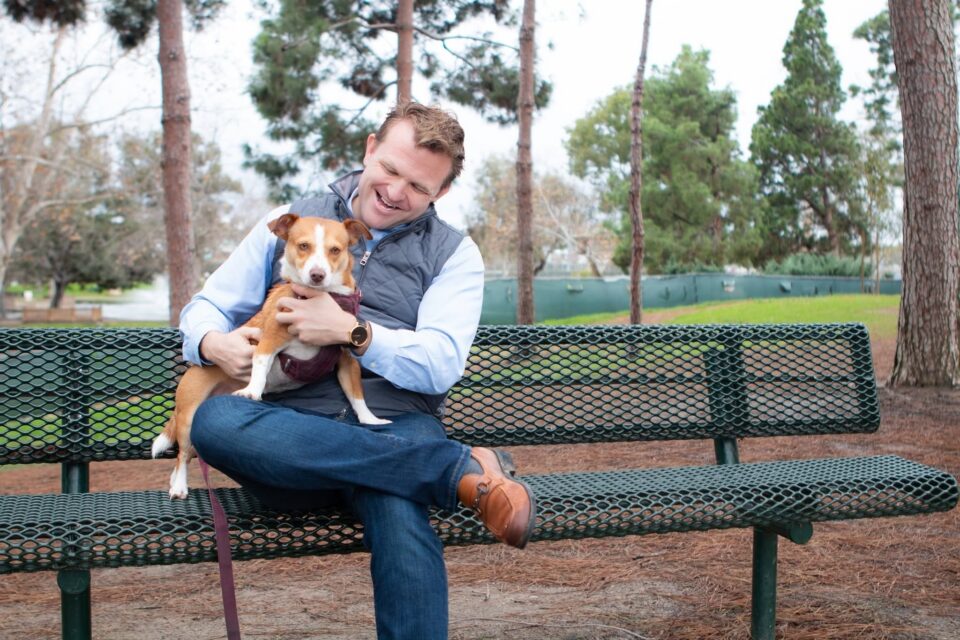
“The current majority does too much where nothing needs to be done, and not enough where much needs to be done,” said the candidate for Costa Mesa City Council District 5.
In less than one week, residents of Costa Mesa’s Fifth District will decide which of two candidates will replace City Councilwoman Arlis Reynolds, who is termed out from running for reelection. The choice is between Steve Smith and Kelly Brown. We reached out to both Smith and Brown to complete candidate profiles on their respective races.
After more than a month, and repeated follow-ups, we never received a response from Brown. What follows is our candidate profile on Smith.
Steve Smith is a longtime Costa Mesa resident. His campaign website says, “By day, he’s a technology professional working in enterprise contact center systems; by night, he’s a hands-on member of the community, serving on the City’s Animal Services Committee, where he helps advise the Council on pet licensing, live release rates, and the programs that keep Costa Mesa’s animal care system running well.”
“I’m running because our city is taking on water right now because of misaligned and ill-defined priorities,” Smith said. “For example, on one hand, the city wants to grow its population. On the other, it wants to shrink its environmental footprint. Both are reasonable goals, but the way we’re pursuing them, they contradict each other.”
He points to bicycle infrastructure as an example. Adding bike lanes can reduce road capacity, he argues, even as population growth puts more vehicles on the streets. Smith objects to a planning model that commits money based on anticipated changes in behavior rather than demonstrated demand.
“Among the majority of the city council, there are clear signs of a poor and disconnected view of what is happening in our city,” Smith said. “The current majority does too much where nothing needs to be done, and not enough where much needs to be done.”
He described this as a “decide and provide” model, in which the city commits resources based on projected usage while relying on future changes in residents’ behavior to justify the investment.
“The payoff depends on future behavior that may very well never show up,” Smith said.
Smith argues that the city then becomes trapped by its own spending decisions, defending investments rather than reconsidering the assumptions behind them. When asked if he believes Costa Mesa’s past leadership has moved the city in the right direction, Smith says no, though he doesn’t think it’s ill-intentioned: “I think it’s a combination of poor priorities and drift.”
“We’ve substituted planners’ preferences for the choices residents actually make,” he said.
His proposed alternative is a renewed focus on public safety, financial management and improving residents’ lives. He identifies state-mandated housing as the city’s most immediate challenge over the next four years, arguing that Costa Mesa must plan for the infrastructure and services needed to accommodate new residents.
“The state sets the number, but the city still decides where the housing goes, in what order, and what has to be in the ground first,” Smith said.
Roads, water, sewers, parks and public safety staffing must keep pace with development, he said. Rather than responding to infrastructure problems after construction, Smith wants the city to establish the necessary improvements before residents move in.
Naturally, this brings up the matter of the Fairview Developmental Center. Smith supports housing at the site, acknowledging that the state requires it and that the property is one of the few places in Costa Mesa where significant housing can go. His objection is to the development plan, not the people who will live there.
The city certified environmental review for up to 4,000 units, while the adopted plan calls for 2,300. Smith warns that state incentives could push the number higher.
He also points to the site’s limited access. Fair Drive is essentially its only regular access road, while Merrimac Way is limited to emergency access. A city traffic study projects two intersections, Harbor Boulevard at Fair Drive and Placentia Avenue at Victoria Street, falling to level of service E during the evening peak by 2045, below the city’s LOS D standard.
With the plan adopted and the state moving to select a master developer, Smith says the next council must ensure the development matches what was promised. He wants secondary access resolved before residents move in, traffic improvements phased alongside construction and parks delivered with the housing.
“The old plan was a bad one; the much lower unit count we have now is a step in the right direction,” Smith said.
On the subject of poor decisions, Smith brought up Fairview Park. In 2007, the city allowed radio-controlled gliders and electric planes, with a permit and liability insurance. By 2021, flying was restricted to gliders. In 2023, the city limited flying to the first and third Saturdays and required Harbor Soaring Society membership.
The restrictions affect Harbor Soaring Society, which has flown at the park since the 1960s. Smith argues that the city has focused on restricting an established activity while neglecting concerns about ranger and enforcement funding raised by the state Department of Fish and Wildlife. The department’s Sept. 25, 2025, letter also said it “strongly supports relocation of the model airplane fly field.”
“Each restriction might be defensible on its own, but together they show a pattern of squeezing traditional uses instead of managing the park,” he said. “Meanwhile, the state Department of Fish and Wildlife has flagged inadequate ranger and enforcement funding at the park. That’s the actual gap.”
“The budget follows the same pattern,” he continued. “Recurring shortfalls keep getting covered with one-time money, which pushes the problem into next year instead of solving it.”
His work on the Animal Services Committee has brought him into the debate over the city’s emergency contract, which he says costs $48,000 per month through the end of 2026. Smith has raised the issue before the full council and urged officials to address it before a month-to-month arrangement increases the price.
“That is the kind of budget leak that got us into our current financial situation in the first place,” he said.
We wrapped up by asking if there’s anything else he’d like our readers to know. In response, he outlined his five commitments, which include protecting Fairview Park and its traditional uses, taking property crime seriously, closing the structural budget gap without cutting core services, cutting red tape for local businesses and making city government more transparent.
Smith says his campaign is funded by people who live in Costa Mesa and that he has not accepted money from developers. Smith lists his endorsers as Sheriff Don Barnes, Assemblymember Diane Dixon, State Senator Steven Choi, Councilmember Jeff Pettis, Councilmember and mayoral candidate Mike Buley, and the Orange County Taxpayers Association.
