

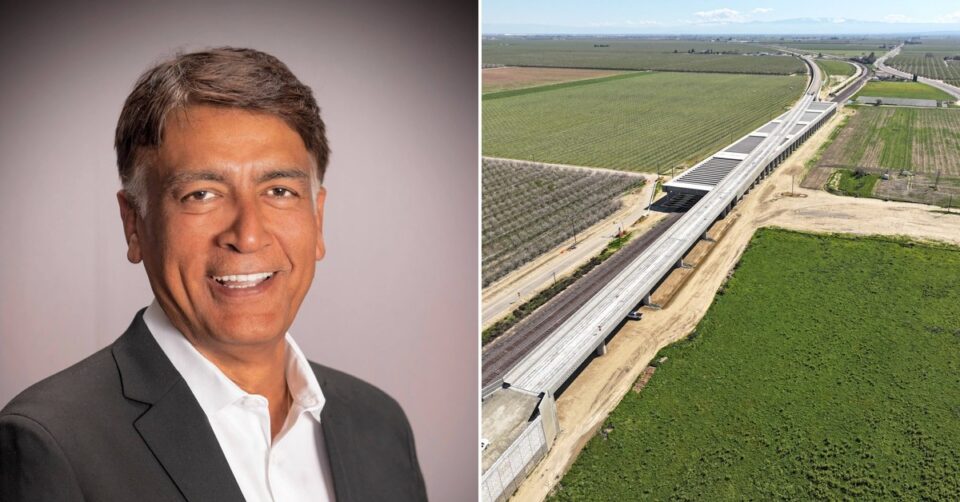
Finance Director Joe Stephenshaw takes over Tuesday as interim CEO of an agency where the high-speed rail inspector general found 69% of reviewed consultant travel, or $800,900, lacked advance approval.
Ian Choudri resigned as chief executive of the California High-Speed Rail Authority late Wednesday, effective immediately, citing personal and family reasons. Board Chair Steve Kawa confirmed the resignation at Thursday’s board meeting, KCRA reported.
In an email announcing his exit, Choudri said he needed to focus on “important personal and family priorities,” according to CalMatters, which obtained a copy and first reported the resignation. Choudri did not respond to CalMatters’ requests for comment Wednesday night.
The board named Joe Stephenshaw, director of the state Department of Finance, as interim CEO on Thursday. Authority Chief of Staff Mark Tollefson will be “active” until Stephenshaw starts, according to comments at the meeting reported by The Sacramento Bee.
The resignation came weeks after the Office of the Inspector General, High-Speed Rail, an independent state watchdog over the project, found the agency often paid for consultants’ travel without approving it in advance and covered trips to gyms, an escape room and a nightclub with no documented state business purpose.
Kawa said the news “reflects the board’s commitment to accountability and transparency” and that “Californians deserve a project they can trust,” CalMatters reported. He also said “we wish him and his family well,” according to the Bee.
WHAT THE WATCHDOG FOUND
The inspector general’s Sept. 15 report, No. 2026-INV-08, said the authority paid more than $2 million in travel-related costs for consultants at four firms in fiscal years 2024-25 and 2025-26. Investigators reviewed roughly half of that spending.
For about 69%, or $800,900, of the travel payments reviewed, the authority had not approved the travel before it occurred, according to the report, which the inspector general updated to correct a summing error. Investigators also flagged $81,000 that appeared unallowable under state travel rules, including flight and rideshare upgrades, and $543,000 that was not allowable under the firms’ contracts.
Counting expenses that fell into both categories only once, the report puts the combined total at $595,600.
The authority often paid the bills “because of direction or an assumption that the CEO or a member of the executive team requested or desired the travel,” the inspector general wrote. It reimbursed one legal consultant for more than 30 travel claims in about a year, nearly all for trips from Denver to Sacramento, at a total cost of $127,300, including $86,500 for time spent traveling.
“Paying for travel when it is not necessary or when it exceeds what is allowed by state regulations or the contract terms is waste of public funds,” the report said.
In an Oct. 9 response to the board, the authority said, “Any expense confirmed ineligible will be recouped by the Authority from the respective consultant contract.” That same day, the board voted 7-2 to strip Choudri of his sole power to sign contracts under $25 million, CalMatters reported.
On Wednesday, authority staff reported that the consulting firms have paid nearly $1.3 million in reimbursements, CalMatters reported.
‘IRREVERSIBLE’
Choudri, whom the board named CEO in August 2024, took office Sept. 16, 2024. He defended his record on the way out. “Over the past two years, this project has evolved from one facing significant challenges to one that is now irreversible and on track to deliver the first true high-speed rail system in North America,” he wrote, according to a letter obtained by CBS News Sacramento.
The project’s costs have climbed. The authority’s 2026 business plan puts Phase 1 at $126.1 billion under what it calls an optimized approach. When voters approved a $10 billion bond in 2008, the San Francisco-to-Los Angeles line was projected to cost $45 billion and open by 2020, CalMatters reported.
In July, the inspector general warned that the authority will exhaust its current funding as soon as December 2027 if it does not secure financing. Under Choudri, the agency also lost $4 billion in federal funding after repeatedly missing deadlines to buy trains, CalMatters reported.
Choudri was also arrested in Folsom in February on suspicion of domestic battery. The Sacramento County district attorney declined to file charges, citing insufficient evidence, KCRA reported. Choudri took a brief leave of absence, according to the Bee.
REACTION
Assembly Republican Leader Alexandra Macedo (R-Tulare), who had called for Choudri’s firing, said in a statement that the project “continues to be a black hole for taxpayers.” She said the board must ensure Choudri “is not allowed to transition into a highly paid private consultant for the project at the public’s expense.”
State Sen. Tony Strickland (R-Huntington Beach), vice chair of the Senate Transportation Committee, said in a statement that the authority has had four CEOs since 2010. “Instead of reshuffling the chairs on the Titanic, it’s time to pull the plug on the high-speed fail and deliver immediate relief to struggling Californians paying the nation’s highest gas taxes,” he said.
A spokesperson for Gov. Gavin Newsom said the governor brought “fresh leadership onto the High-Speed Rail Authority Board this year, with a clear charge to demand accountability for every dollar” and “welcomes today’s announcements as an important step in that direction,” KCRA reported.
THE ANAHEIM LINK
At the same meeting, the board considered staff recommendations on the Los Angeles to Anaheim section, including certifying its final environmental impact report. The board approved all agenda items related to moving that section forward, the Bee reported.
Stephenshaw, who has led the Department of Finance since July 2022, according to CalMatters, takes over at the rail authority Tuesday, the Bee reported.
