

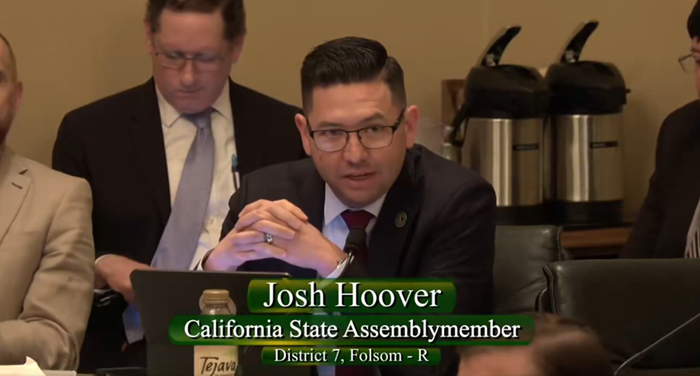
“It is a very clear weaponization of this Committee for political purposes,” said Assemblyman Josh Hoover.
In what is definitionally an unprecedented move, California’s Joint Legislative Audit Committee is considering auditing the Orange County Board of Education (OCBE) regarding its administrative practices, approval of charter school applications, and the use of outside counsel over the last five years.
This move, first placed onto the agenda for consideration by Senator Tom Umberg (D-Santa Ana), is widely being panned as highly partisan maneuver aimed by the Democrat supermajority in Sacramento to extend influence and control over a local school board; one which has long been in the crosshairs of the California Teachers Association—the state’s most powerful public school teachers union—and the candidates they bankroll. Umberg is one such candidate.
During a last month’s meeting of the Joint Legislative Audit Committee, Assemblyman Josh Hoover (R-Folsom,) expressed his concern that this establishes a dangerous precedent: “It is a very clear weaponization of this Committee for political purposes.”
When asked by Hoover if the California State Auditor’s Office has ever audited a county board of education, State Auditor Grant Parks said “I can’t think off the top of my head what that number is, but if we have, I would imagine it’s very small.” He also confirmed that such an instance has at least not happened during his tenure, which began in January 2023. Parks has worked in the California State Auditor’s office since 1999.
“Senator Umberg’s audit request lacks any factual predicate whatsoever… Here are the facts. There have been no formal complaints against the Orange County Board of Education in the last five years. None,” said Greg Rolen, general counsel for OCBE.
Rolen went on to state that there have been no Title VI, Title IX, or IED complaints filed against the Board; no Brown Act “cure and correct” demands; no Public Records Act litigation; no Political Reform Act complaints; no whistleblower or retaliation cases; no taxpayer actions; no criminal referrals; and no allegations of public contract code violations.
The only litigation the Board was involved in was found to be in complete accordance with state law, and many of those cases focused on pushing back against overbroad mandates during the state-ordered COVID-19 lockdowns. A number of those cases were handled pro bono—at no expense to taxpayers.
He also pointed out that the Board has rendered 33 charter decisions, with only one of those decisions being challenged before ultimately being upheld by the state’s own Board of Education. If the myriad statutory enforcement mechanisms were never triggered, the OCBE appears to have acted well within the scope of its duties.
Using outside counsel is “something that every single school district in the state of California does” and approving charter schools is “quite literally one of the main roles of a county board of education,” argued Hoover. The Assemblyman also stated that overruling administrative staff on a decision surrounding charters is “not evidence of wrongdoing.”
He’s correct.
Despite all this, the vote fell largely on party lines with a majority of legislators supporting the audit. The bill was placed on call.
What, then, did the Board do wrong? Rolen argues it comes down to “Senator Umberg’s more subjective concerns” including “ideological influence or fiscal prudence” for which there is no legal recourse.
“But there is recourse at the ballot box,” Rolen said. “And the Board Trustees have won eight of the last elections, losing none… The voters have spoken and will continue to speak.”
This is the fourth time in the last three years in which members of Umberg’s caucus have introduced bills aimed at exerting control over OCBE. Past attempts included SB-907, which would have allowed Sacramento to change the number of Trustees, and SB-249—directly authored by Umberg—which would have forced school board elections to coincide with general elections in an attempt to boost voter turnout.
Tom Sheehy, who also represents OCBE, argues this is because “they haven’t been able to beat them at the ballot box and they don’t like the fact that [the Board] supports charter schools and parental rights.” He also accused Umberg, who lives in the district, of never having attended a single OCBE meeting or talked to one of the OCBE Trustees—via letter or otherwise.
“It’s unfortunate that the current climate in Sacramento has become so polarized that a duly elected board continues to face repeated attempts to change its composition by altering the rules governing its elections,” said Sheehy.
Assemblymember Carl DeMaio (R-San Diego) pointed out the Committee’s hypocrisy in that, one year ago, it decided against auditing Coachella Valley Unified School District despite its “laundry list of corruption and mismanagement and ethics violations and financial transgressions” because “a powerful Senator said that they did not want to have an audit, the audit was killed.”
“Now we are here with a school board that has a pretty darn good record—a stellar record. Their only demerit is they allegedly are approving too many charter schools, that they haven’t always caved into the union… and, of course, they have sued the state of California for bills that go against parental rights,” DeMaio pointed out.
Meanwhile, the state continues to leverage lawsuits against the Trump administration, many of which are dismissed immediately and are—critics would argue—more for political theater and posturing than actually affecting change. When Hoover asked Umberg if he knew how many times Attorney General Bob Bonta sued the Trump administration, Umberg answered that he did not know the answer. Hoover responded that the answer was 44 in this term alone, at a cost to taxpayers at around $50 million.
As of early April 2026, some sources have it as high as 60. That’s on top of the 123 lawsuits California filed against President Trump during his first term.
Whether the audit ultimately goes through or fails remains to be seen, but it will assuredly not be the last attempt by Sacramento to broaden the scope of its authority over OCBE. We will continue to cover this story as it develops.
“This issue is about more than one board or one political disagreement,” wrote Hoover in a recent newsletter. “It is about protecting the rights of local communities to make decisions and ensuring that the state government does not use its authority to intimidate or retaliate against those who disagree with it… We must draw a clear line and defend the principle that elected local boards should be free to represent the people who chose them.”
