

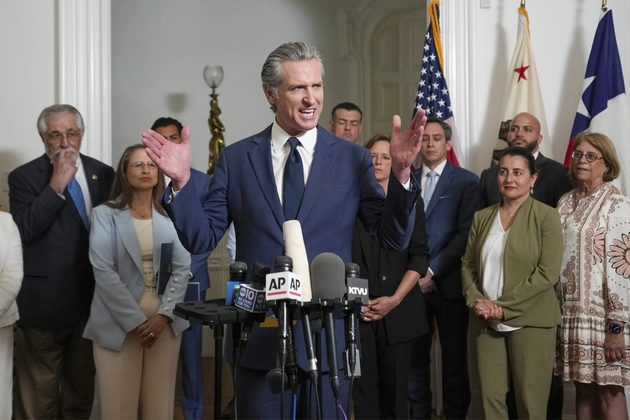
Supporters of the current commission outnumber proponents of returning map-making power to the legislature by nearly two-to-one.
A new POLITICO-Citrin Center-Possibility Lab poll shows that California voters overwhelmingly oppose Governor Gavin Newsom’s proposed plan to override the state’s independent redistricting commission. Sixty-four percent of voters want to preserve the current voter-appointed body, while just 36% favor returning map-making authority to the Legislature.
The high level of support for the independent commission spans party lines–72% of independents, in particular, back the commission.
Newsom’s proposal, branded the Election Rigging Response Act, framed the effort as a reactive measure to Republican-led gerrymandering in states like Texas. His plan would temporarily shift redistricting power to the Legislature for maps in 2026, 2028, and 2030, then return that authority to the commission after the 2030 census.
Despite Newsom’s strategy and partisan messaging, public skepticism remains strong. Internal polling reportedly shows only a narrow 52% initial approval for the legislative redistricting approach, and among policy influencers, 61% oppose the plan. Support from the Democratic insiders is slight—just 51%.
Rep. Kevin Kiley (R-CA), one of the congressmen whose district stands to be altered, has spearheaded a legislative response. Kiley announced plans to introduce H.R. 4889, a bill that would prohibit all mid-decade redistricting nationwide—countering Newsom’s proposal and defending the commission system.
In a press release, Kiley stated, “Gavin Newsom is trying to subvert the will of voters and do lasting damage to democracy in California,” he said. “Fortunately, Congress has the ability to protect California voters using its authority under the Elections Clause of the U.S. Constitution.”
Early drafts of the proposed maps aim to eliminate five Republican-held seats–including those held by Reps. Kevin Kiley, Doug LaMalfa, Darrell Issa, David Valadao, and Ken Calvert—while consolidating Democratic gains in battleground regions such as the Central Valley and San Diego County areas.
Democratic leaders, including Assembly Speaker Robert Rivas, argue that voters will receive ample time to review the maps before casting ballots. Yet critics warn the compressed timeline, plus partisan messaging, risks confusing voters and reducing turnout or support—even among the Democratic base.
For Newsom, the November 4 special election is more than a technical adjustment to district boundaries—it’s a calculated gamble that California voters will side with partisan power over independent oversight. But with polling showing a decisive preference for the commission, even among young Democrats, his plan faces a credibility gap that no amount of campaign messaging may close.
If the measure fails, it could deal a blow not only to Democratic hopes of flipping multiple GOP-held seats but also to Newsom’s national ambitions as he eyes a potential 2028 presidential run. If it passes, Republicans like Rep. Kevin Kiley warn it will confirm fears that partisan gerrymandering is alive and well in the Golden State—this time under Democratic control.
