

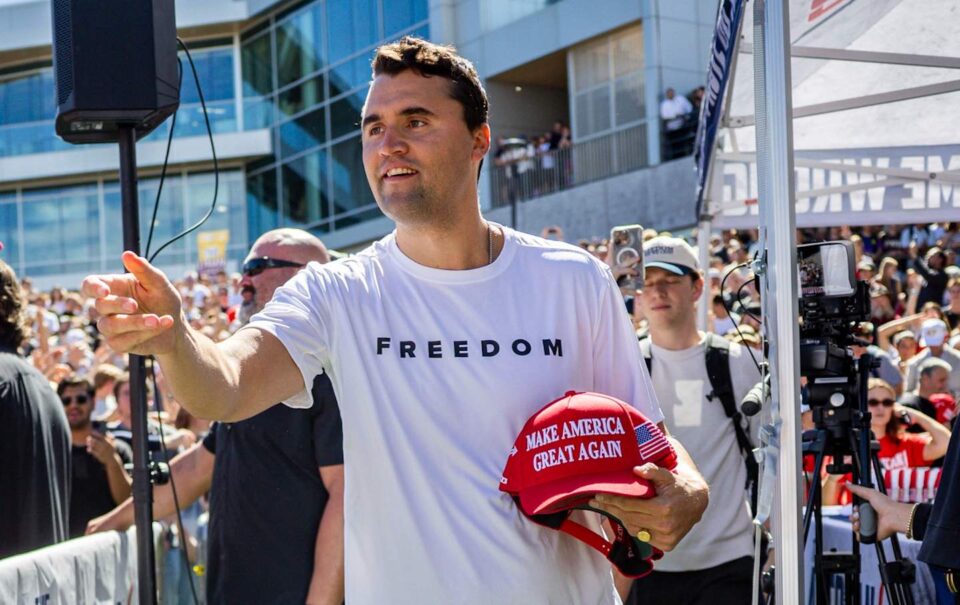
From the assassination attempt of President Trump, to vandalized Teslas, to Charlie Kirk’s murder, a pattern of politically-charged violence against conservatives reveals growing unrest.
Violence against conservative figures and symbols has increasingly drawn national concern in the United States, especially as high-profile attacks—like the assassination of Charlie Kirk and multiple attempts on Donald Trump’s life—have raised alarms about political safety.
These incidents, combined with smaller-scale assaults and property destruction, suggest a volatile climate in which partisan identity is becoming a flashpoint for violence.
On September 10, 2025, conservative activist Charlie Kirk was fatally shot while speaking at Utah Valley University. Prosecutors have charged Tyler Robinson with aggravated murder in what Utah’s governor called a “political assassination.”
In another highly publicized case, President Donald Trump survived an attempted assassination at a rally in Butler, Pennsylvania, on July 13, 2024.
An attendee was killed, others were wounded, and a bullet grazed Trump’s ear. The gunman, Thomas Matthew Crooks, fired from a rooftop before being shot and killed by a Secret Service sniper. A bipartisan investigation later identified “stunning security failures” in the handling of that event.
Another attempt occurred at Trump’s golf club in West Palm Beach, Florida, when Ryan Wesley Routh allegedly plotted for weeks to assassinate Trump. On Sept. 15, 2024, he was found hiding in shrubbery with a rifle; a Secret Service agent spotted him before Trump came into view, fired a shot, and Routh fled. No shots were fired at Trump.
At the University of California, Davis, masked demonstrators disrupted, dismantled, and stole the entire tabling event at a “Prove Me Wrong” event hosted by Turning Point USA featuring Brandon Tatum.
Protestors were seen on video pulling down tents, damaging equipment, and assaulting event staff, including Tatum. The university is investigating and condemning the violence, although campus police were not seen involving themselves during the demonstration.
Meanwhile, conservative symbols and property linked to prominent right-leaning figures have been vandalized. Tesla vehicles, dealerships, and charging stations have been damaged or destroyed in arson and vandalism incidents across multiple U.S. states since early 2025—in protest of Elon Musk’s support and involvement in the Department of Government Efficiency.
Authorities and political leaders have labeled these acts “domestic terror” amid concerns that such attacks are ideologically motivated.
On social media platforms like Bluesky, users threatened prominent conservatives, including Ben Shapiro, Elon Musk, and Matt Walsh. Some posts explicitly said they hoped someone would “shoot Ben Shapiro next,” while others called for further attacks on high-profile right-leaning figures, according to the New York Post.
Ben Shapiro himself has reacted with alarm. In a recent interview with The Free Press, he said he has told his security team he will no longer do outdoor events, arguing that such venues expose speakers to “too many vantage points, there are too many overlooks.”
Shapiro said recent events make clear that conservative commentators are being singled out, and that the nature of public speech is becoming riskier.
Even as threats mount, many conservatives insist they will continue speaking out. “We Are Charlie Kirk” has now become a slogan of the political right. Yet the challenge remains: how to preserve robust public debate and free expression while ensuring that safety and accountability are not sacrificed in the process.
The threat of political violence against conservatives is not new. The 2017 congressional baseball practice shooting left Rep. Steve Scalise critically wounded, the 2019 firebombing of a Tacoma ICE facility was carried out by an Antifa-linked anarchist, and “Jane’s Revenge” firebombed and vandalized pro-life centers across the country in 2022.
That same year, a man armed with a gun and tactical gear was arrested outside Justice Brett Kavanaugh’s home with the intent to assassinate him. More recently, two separate attempts on Donald Trump’s life—in Pennsylvania and Florida—demonstrate how persistent the danger has become.
According to Capitol Police, members of Congress faced nearly 9,500 threat cases in 2024, with Republicans like Sen. Marsha Blackburn, Sens. Ted Cruz and Deb Fischer, and Rep. Marjorie Taylor Greene all named in recent federal indictments involving death threats.
Analysts note that flashpoints over abortion, immigration, and election integrity have fueled this escalation, creating what security officials now describe as an “ongoing risk environment” for conservative leaders.
