

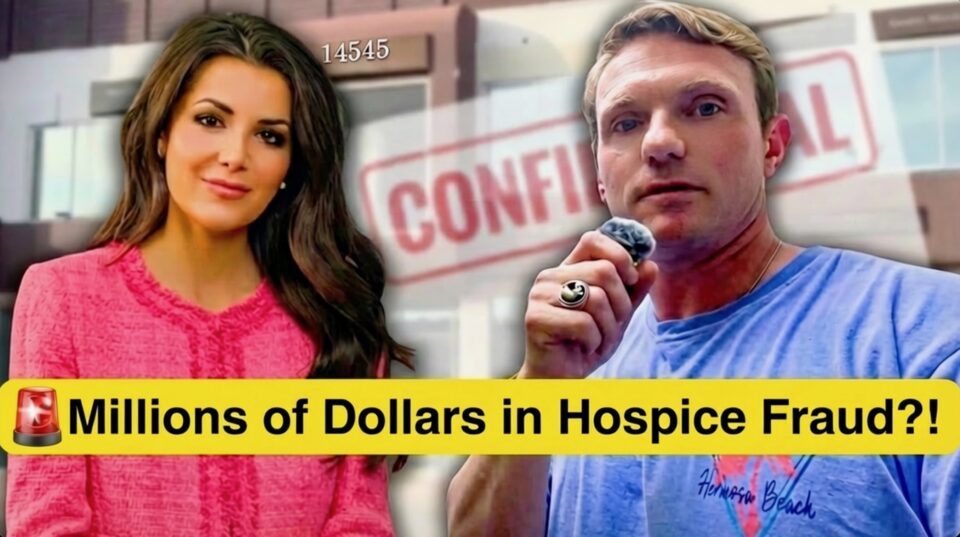
“We need to fix the loopholes in the administration of these programs—and the blind spots that, unfortunately, bad people have gotten ahold of—and find a way to expose that,” said Assemblywoman Alexandra Macedo.
Roughly 3% of all Americans live in Los Angeles County. Of that population, less than 16% are considered elderly. Despite that fact, L.A. County alone holds nearly one-third of all hospice and home health companies in the United States of America.
Why do so many hospice providers want to be registered in L.A.? Investigators for the California Courier went searching for answers and what we uncovered is staggering.
California Courier investigative journalists uncovered a sprawling network of suspicious hospice registrations across Los Angeles—multiple companies tied to the same addresses, overlapping staff across supposed competitors, and phone numbers that lead nowhere. Investigators now have a name for it: “ghost hospices”—operations that exist on paper, collect money, and appear legitimate, but have no real-world presence.
To see it firsthand, California Courier partnered with Assemblywoman Alexandra Macedo (R-Tulare) and went into the field for a firsthand look at the hundreds of supposed hospice facilities throughout Van Nuys, Hollywood, and the greater San Fernando Valley.
“I started investigating why we’re spending historic numbers on health care in the state of California but we’re not seeing results as far as quality of health care or the services provided,” said Macedo during the interview. “I started trying to figure out who oversees what—and what exactly information is publicly available… I found hot spots of hundreds of hospices all registered to one address.”
Macedo then described the experience of visiting these sites—many of which were in “dilapidated buildings” that are not ADA-compliant and “empty, vacant lots”—and her difficulty in reaching any of these businesses via phone. Many numbers led to disconnected lines and free Google Numbers.
While not immediate proof of wrongdoing, a business having a Google Number can be considered a red flag primarily because—while it is a legitimate service—these numbers are virtual, free, anonymous, easy to create, and not directly tied to a physical SIM card or a traditional carrier contract. That layer of separation has made them a favored tool of fraudsters and those seeking to hide their identity.
When California Courier and Macedo began calling supposed hospices in the Valley, the two frequently encountered the same phenomena. In the instances where they were able to reach someone, responses were oddly hostile.
“I don’t have to answer your questions,” one supposed hospice worker told California Courier Investigative Journalist Christian Hartsock before hanging up.
California Courier and Macedo found one instance where over 80 hospice companies were registered to a single crumbling building in Los Angeles. Hundreds more were found within only a few blocks.
See a list of hundreds of hospices in the area here.
Upon arrival at the first building, 14545 Friar Street in Van Nuys—the location of businesses like Caring Love Hospice and Miracle Touch Hospice, both of which have no Google or Yelp reviews—Macedo immediately noticed the lack of handicap parking and wheelchair ramps. That is, frankly, an alarming site for a property allegedly housing health care facilities.
“If you have hospice patients that are likely in wheelchairs, wouldn’t you think that they would have handicap accessibility?” said Macedo.
Across all the properties they visited, Macedo and Hartsock repeatedly encountered the same telltale signs: locked doors with notes reading “Out to Lunch,” disconnected phone numbers, and empty offices collecting dust, all while allegedly billing Medi-Cal for patient care.
Other signs included “Working Remote Due to COVID Exposures” and “Emergency – Back in 15 Minutes.” Many of these signs seemed more or less permanently fixed to the door, as opposed to sticky notes or some temporary notice. These signs adorned dozens of businesses well past normal lunch hours and were still hanging in place after repeated visits across multiple days.
In some rare cases, knocking on the door actually did result in alleged hospice workers answering the door—but quickly turning the inquirer away.
“No, this don’t hospice [sic],” said one woman emerging from Gloria Home Health Inc., a business with no social media presence.
“What kind of health do you provide here?” asked Hartsock.
“I’m sorry. You can’t come,” the woman replied as she closed the door.
The interaction took place during the post business hours.
“As of 2026, in order to be in compliance, they have to have open business hours and a working phone number,” Macedo points out. Effectively none of the businesses they examined meet this criteria.
The Centers for Medicare & Medicaid Services (CMS) conducts a national Hospice Survey which evaluates and scores hospice providers. The website National Hospice Analytics does the same. Notably, most of the businesses investigated by Macedo and Hartsock do not even provide enough information publicly to be accurately evaluated by these programs—and many had a 0% death rate.
How can this even be? For context, around 90% of patients in hospice care die within six months of admission, according to data published by the National Institutes of Health.
“Los Angeles County hospice agencies have unusually long durations of patient care and high rates of patients being discharged alive,” reads a 2022 report by the California State Auditor’s Office. “Given that hospice patients are by definition in the last stages of their life, these trends seemingly indicate that at least some hospice agencies are enrolling patients who are not eligible for hospice services because they are not actually suffering from terminal illnesses; at the same time, those patients may experience being deprived of the curative care that they need.”
“We also found cases where hospice agencies appear to be using the names of medical professionals without their knowledge or consent, thereby obtaining hospice licenses under false pretenses,” the report continued. “In these instances, it is not clear who—if anyone—is providing care to patients.”
That’s exactly what Macedo believes is at play today: “What I suspect is happening—or has happened—is maybe some of these are social security numbers or seniors that have been scammed into providing their information. These people are then using that information to enroll them in hospice.”
“They reach their max hospice benefit that they can get for that person with that hospice care… and they kick them off hospice. And then they kind of recycle this information and give it to one of their buddies who’s also doing the same thing until they get caught,” Macedo explained.
Perhaps that’s the real reason why, at another business in the same building, Hartsock had a door closed on his face while asking a worker about care for his sick mother.
In what is perhaps the video’s tensest moment, Hartsock finds a suite belonging to an auto repair shop. Notably, this business is on the second floor of the building, which is highly unusual for auto repair. It also has no reviews on Google or Yelp. When Hartsock asks the man working at Wyllys if he knows anything about the myriad hospices that surround his business, the man calls 9-11.
“Some person coming to building and he asking some questions; ‘Who you are?’; “Why you are here?’; ‘What kind of business you doing?’ [sic],” the man tells the Los Angeles Police Department operator. “I want to know who is this person [sic].”
The video footage then shows the man pushing—possibly hitting—Hartsock with the back of his hand, arguably assaulting him.
Over $3.5 billion in Medi-Cal fraud has been identified in Los Angeles County alone. Over 700 of roughly 1,800 hospice agencies in L.A. County have been flagged with two or more fraud indicators.
On top of that, Governor Newsom missed a January 2026 deadline to implement emergency regulations that were first ordered after the same fraud was uncovered as early as 2020. This has undeniably created an ecosystem that practically invites fraud to fester and grow like bacteria in a petri dish. It has gotten so widespread that the FBI’s Joint Terrorism Task Force and CMS are now involved, as federal officials are demanding a comprehensive action plan from Newsom within the coming weeks.
“I know there are good hospice providers in the state of California. And that is why we need to fix the loopholes in the administration of these programs—and the blind spots that, unfortunately, bad people have gotten ahold of—and find a way to expose that,” said Macedo.
For her part—beyond her own investigations—Macedo said that she is working on active legislation and letters to both the California Department of Health and Human Services, which holds ultimate oversight over these programs, and Governor Newsom to “correct the issue and… bring these people to justice.”
“I’m going to make sure that Gavin Newsom is going to put it in law that in order for you to have a license, you are doing all of these things—and if you don’t, then stay out of our business so we can help these people that actually need it,” she said.
Until then, she hopes taxpayers will continue to pay attention to what’s being done with their hard-earned money.
“I’m a taxpayer and I’m angry too,” she said. “I just got to the Legislature. I just found this. But I can promise you I am not giving up this fight and I will continue to bring awareness to this until justice is brought.”
