

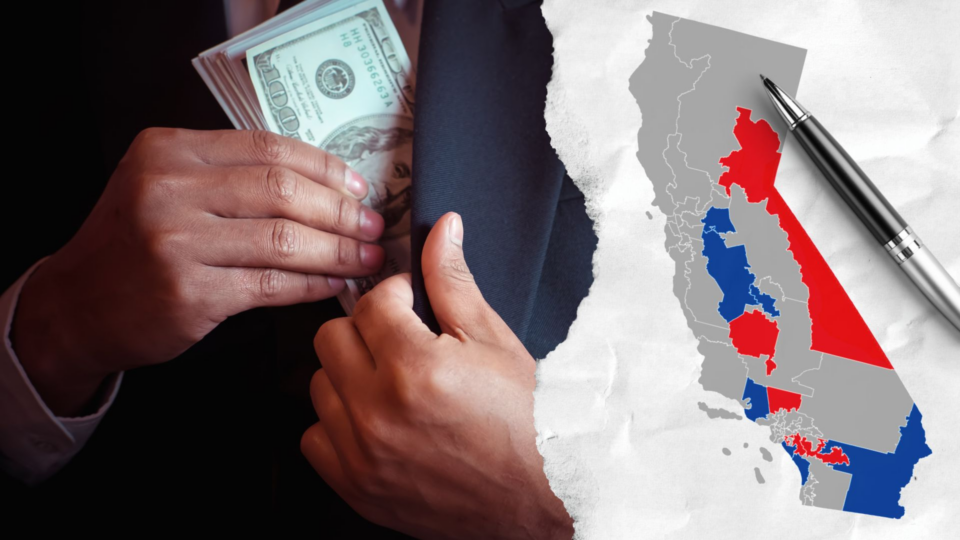
“California’s public sector unions are not only the most powerful political special interest in the state, but most of them are nakedly partisan,” said the California Globe’s Edward Ring.
Why does so much legislation pass in California that feels wildly out of step with the people who live here?
Despite the reputation that Californians may have in other parts of the nation, the current state of California as a bastion for progressive legislation has less to do with voters themselves and more to do with powerful special interests—especially public sector unions with the money and muscle to shape the Golden State to their liking.
A recent report from the California Policy Center (CPC) sheds stark light on just how much financial firepower public sector unions wield and how that influence shapes policy across the state—and why that always comes back to benefit unions over all else.
The report’s headline figure is eye-popping to say the least. Public sector unions in California generated nearly $921 million in annual revenue in 2018, and tremendous sums of that figure are spent on lobbying and electioneering. Because the figures are nearly eight years old, the real amount could be considerably higher—perhaps even upwards of $1 billion.
The biggest among them is the California’s Teacher Association with its estimated annual revenue of $356.3 million. Other big players include the California Federation of Teachers; California’s Police Unions; and the American Federation of State, County, and Municipal Elections—all of whom boast over $100 million in annual revenue.
To put that in context, state and local governments spend roughly $240 billion each year on public employee compensation and benefits. With so much on the line, one can understand why unions “work so hard to control elected officials in California,” in the words of Stanford University Public Policy Lecturer David Crane.
“It’s not like collective bargaining in the private sector, where management is controlled by shareholders,” said Crane. “When collective bargaining is permitted in the public sector, management—i.e. elected officials—can be controlled by politically-active labor, and that’s exactly what has happened in California since collective bargaining for public employees was first authorized in 1968. Services have declined ever since, even as taxes have increased.”
With numbers like that, how can ordinary citizens muster enough grassroots support to keep their local school board races from being dictated by a titanic special interest money machine?
Of course, in numerous school districts across the state, that exact scenario has unfolded in spite of parents’ best efforts. Look no further than Orange Unified School District. In 2023, the seven-member Board was relatively-balanced ideologically, with conservative Trustees comprising a narrow four-three majority over progressive candidates. Since then, union-backed campaigns have led to the recall of several members, influenced contract negotiations, reshaped the Board to a seven-zero progressive makeup, and helped hire known progressive activists to once-nonpartisan administrative positions.
Whether you are conservative, progressive, or neither, one must acknowledge that healthy debate and dissent tends to lead to better outcomes. When one side has not only a majority but a totality, they are often emboldened to serve their own self interests, knowing they often cannot be challenged in any meaningful way.
“California’s public sector unions are not only the most powerful political special interest in the state, but most of them are nakedly partisan,” said the California Globe’s Edward Ring. “To have all this power, and merely use it to push for more staff, more restrictive work rules (which equates to more staff), more pay, and more benefits, that would be bad enough… But between the political reality of public sector union power, and the necessary reforms that Californians desperately deserve, are nearly one billion dollars per year of cold hard cash.”
The CPC piece points out that California is a global leader in innovation and industry. That’s all the more reason public sector leaders want in on the private sector pie. But, by that same token, not getting it right risks killing the “golden goose.” In particular, they criticized union calls for Waymo’s operating license be suspended indefinitely after a child ran in front of a self-driving car and—despite the car having slammed on its brakes—was struck at 6 miles per hour.
The child survived. And a moving vehicle can only decelerate so fast. But none of those facts mattered to teamsters.
Despite this, Garry Tran, CEO of Garry’s List, believes there’s a possibility for reform—a chance for unions to support workers and progress simultaneously. But it requires that California enact legislation by which the public can ensure accountability for how public sector unions run—and who leads them.
“I think there’s a pathway via ballot measure to require unions to be real democracies—with leadership elections, term limits, and open audited books,” said Tran. “If they refuse? Right-to-work laws trigger. Wisconsin did it. California could too.”
