

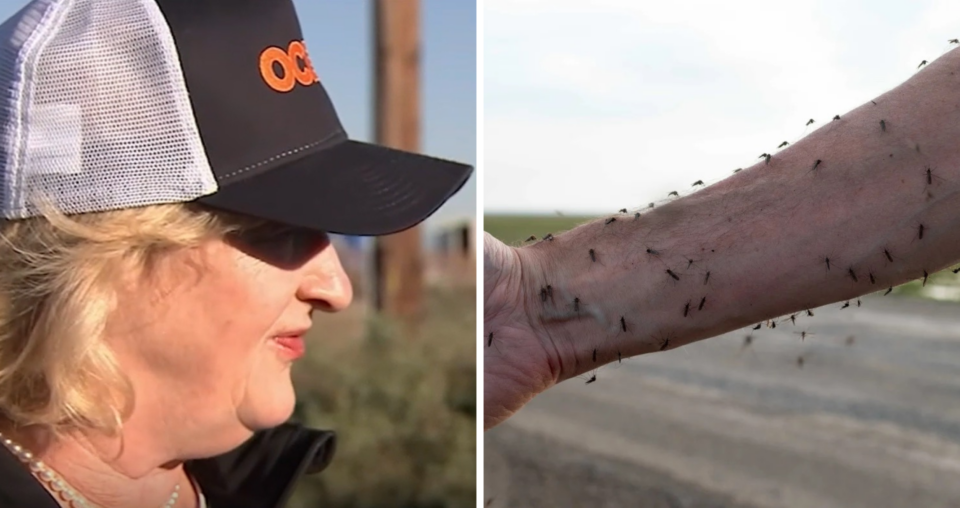
There may still be a way for Newport Beach to fulfill its housing mandates, restore important habitats, prevent mosquitos from spreading, and save taxpayers from bankrolling a risky, expensive habitat restoration project.
Since its inception in June 2023, Orange County Supervisor Katrina Foley appears to have only ever shown support for the Santa Ana-Delhi Channel Improvement Project, a proposal to spend roughly $30 million to convert 10 acres along the Mesa Drive corridor in Santa Ana Heights into marsh habitat. After chairing a meeting of the Newport Bay Watershed Executive Committee back in 2024, Foley claimed that “the project will revitalize the channel and provide natural habitats for birds, insects and animals that call the area home.”
That is indeed a description of what habitat restoration projects do—at least on paper. But not all projects are the same, and the Santa Ana-Delhi project in particular has no shortage of critics.
Why is this so? Increasingly, critics warn that beneath the surface, the Santa Ana-Delhi proposal carries serious financial costs and public health risks that are growing increasingly difficult to ignore. Opponents of the proposal have pointed out that the project would create serious new public health risks, overlooking the rapid spread of invasive Aedes mosquitoes across Southern California while placing standing water near residential homes and a working vineyard. They also note that the plan disregards community assets promised to residents during the 1998 Newport Beach annexation.
Currently, the area that would be transformed into a marsh is open land with equestrian access. Ever since Santa Ana Heights first became part of Newport Beach around the turn of the century, public officials have thrown support at the idea of a riding arena, along with other amenities for the equestrian community.
Not only were those promises never fulfilled, but officials like Foley are now flirting with the idea of
turning the region into yet another marshland—one which would become a veritable breeding ground for the aedes aegypti mosquito, one of the most dangerous animals on the planet, near residential homes and a working vineyard.
Already, Orange County Mosquito and Vector Control District (OCMVCD) struggles to control the existing mosquito population in Santa Ana. OCMVCD has recently been sounding the alarm on the emergence of West Nile Virus—an mRNA virus that can cause encephalitis, delirium, coma, and death—almost all of which is concentrated in the exact region this project would affect. They advise that citizens “eliminate any standing water around [their] house(s)” to mitigate the risk of infection.
It is of course highly ironic that the county would warn residents to eliminate standing water while also spending $30 million to create much more of it.
Furthermore, there are concerns that the six decades-old channel is not sufficiently designed to account for modern-day climate events. Adding five acres of freshwater retention and modifying levee structures in this corridor could create serious downstream risk for a local residential neighborhood, they argue, and could even put homes in danger if the channel overflows.
One of the arguments in favor of the project is that it addresses habitat loss due to urbanization, dredge and fill material placement, selenium-laden groundwater seepage, and increased storm flows. But there are already existing conservation projects taking place to address this—most of which have already secured funding and are moving into their second and third phases. One such example is the Big Canyon Coastal Habitat Restoration and Adaptation Project, which will restore 14 acres of salt marsh, transitional freshwater wetlands, riparian corridors and upland habitat, to the benefit of at least 12 species of animals.
The total estimated cost of the Big Canyon restoration is $6.5 million—which translates to around $450,000 per acre. Compare this to the $3 million per acre cost of Foley’s Santa Ana-Delhi proposal. That’s a taxpayer overpayment six times over.
But that’s not even where expenses would stop. On top of the $30 million for the project itself, taxpayer funds will also need to commission a new Environmental Impact Report (EIR), as the last one was conducted 35 years ago—in 1991. At that time, the aedes mosquito—an invasive species—was not present in Southern California. Foley’s proposal would necessitate a new EIR, which is guaranteed to be both costly and time-consuming.
Beyond the Santa Ana-Delhi project, there are also proposals for a Surf/Wave Park following the expiration of the Newport Beach Golf Club in 2027 and, on top of that, a state housing mandate which requires the development of nearly 750 housing units and a two-acre park.
Together, that may constitute a devastating habitat loss of over 30 acres of mature trees—in favor of artificial water features—and a bird habitat that will not be replaced.
However, there may be a way for Newport Beach to fulfill its housing mandates, restore important habitats, prevent mosquitos from spreading, and save taxpayers from bankrolling an expensive project. In fact, county Supervisors have known about such a proposal for nearly three years: the Moriarty Botanical Gardens.
This proposal was set forth as an alternative to the $30 million mosquito marsh and would, if approved, create “a public and private garden with a conservatory and event space, dedicated to restoring habitat for owls, raptors, eagles, and ospreys while preserving and expanding the tree canopy and supporting local college horticultural programs.”
The Gardens exist today, albeit at a smaller scale, as part of the Newport Beach Vineyard & Winery’s tropical and botanical garden and bird aviary. It’s currently the only proposal before the county which specifically accounts for Newport Bay’s rare and endangered bird species, including the peregrine falcon, brown pelican, least tern, and more.
Proponents of the Gardens offer it provides all the benefits of Foley’s existing proposal—habitat restoration, sediment management, and community open space—without introducing permanent freshwater mosquito breeding habitat at $3 million per acre.
Opponents of the Santa Ana-Delhi project argue Foley can deliver a major win by reconsidering Moriarty Botanical Gardens. Whether she follows the same trajectory—or moves forward despite the county’s own public health warnings—remains to be seen.
